The longer I live in Madeira, the more I realise that nature is more than a beautiful backdrop that we experience through our senses.
It is a mirror of ourselves. Of our inner world.
Trees stand firm even in strong winds thanks to their deep roots. They remind me that we, too, need a few steady supports — courage, humility and discipline — to be able to accept and work through life’s changes. Changes that come as naturally as the shifting weather — in recent years, sometimes very quickly and intensely. Sometimes from very close to home.
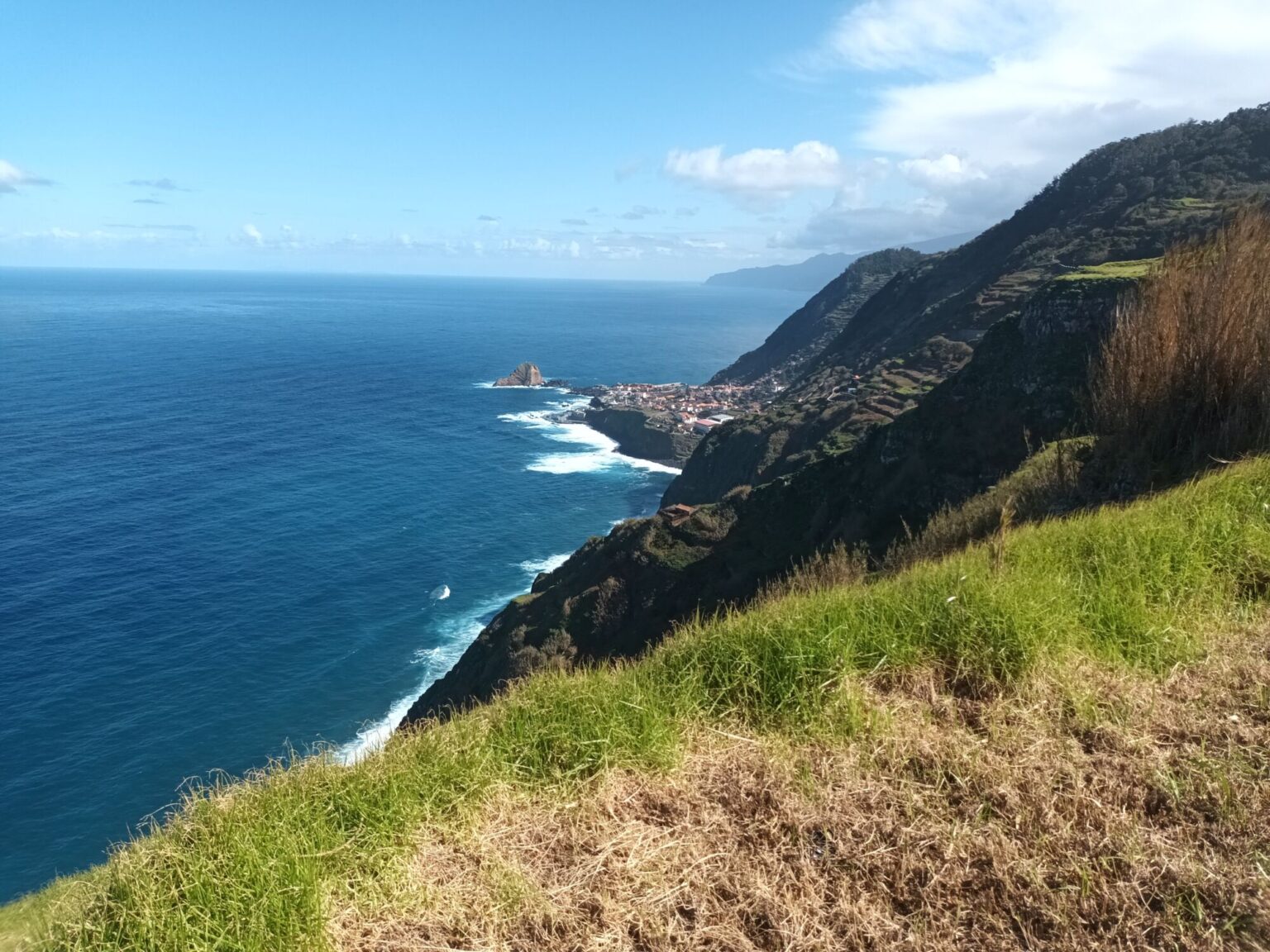
The ocean never stops moving, and yet it has clearly defined shores. Much like our boundaries, which do not separate us from the world, but protect us.
And clouds can hide entire mountains within minutes, only to part a moment later and let the light through again. Like thoughts and emotions, which come and go. We can simply observe them. We do not have to let them engulf us.
Nature does not resist change. It does not try to hold on to something whose time has come to leave. It does not ask permission to let go of a withered branch or its leaves. And it does not apologise for needing time to blossom again.
A river flows. The current carries away smaller stones and branches; it flows around larger obstacles. It does not fight them.
And it keeps flowing.
Nature simply respects its own natural laws.
Perhaps that is why it feels so easy to breathe in nature. Because we humans, by contrast, tend to keep adjusting the natural course of things to match our own idea of how life should work.
We do not flow.
We become caught in our thinking traps, in the demands of our own ego and in patterns we regard as a "safe harbour" simply because they are deeply familiar — often from childhood.
And sometimes it is only in nature that we allow ourselves to set down all our masks.
And breathe freely.
The baggage we cannot see
When I moved to Madeira, I packed my things, closed the door behind me and flew across the ocean towards a new life.
My visible luggage was within the weight allowance.
The invisible baggage had no limit.
I brought far more with me than would fit in my suitcases. Far more than I realised myself. Old stories, long-ago hurts, learned ways of thinking and beliefs I had adopted as my own along the way through life. Some came from early childhood, others from later relationships.
For a long time, for example, I believed that expressing disagreement or setting clear, firm boundaries could cost me love. That saying no meant disappointing the other person, and perhaps even losing them.
That “no” meant being selfish.
That being loved depended on whether I complied, helped, understood, gave way or took responsibility even for things that were not truly mine.
Conditional love can get deeply under our skin.
And when we encounter it later in other forms, it can feel strangely familiar. Not because we want it, but because our mind already knows this way of being close. It has learnt how to navigate it. To anticipate changes of mood, respond, explain and adapt — just to keep the peace at home and at least a semblance of safety. And to look for the fault in ourselves above all.
Learned thoughts gradually become automatic reactions. These influence our emotions, decisions and the way we enter relationships. And so, again and again, they help create a similar reality.
Not because we consciously choose pain.
We simply repeat what we once learnt and what feels “safely” familiar.
But a new life does not come about simply by changing our address. Even the ocean is not wide enough to separate us from what remains unresolved within.
We can fly to the other side of the world, but we cannot escape ourselves.
And that is actually a good thing.
Madeira did not give me a hiding place from the past. It gave me space to return to it differently. From a safe distance, in quiet and with time I had not had before.
Surrounded by nature, I began to learn to listen to myself. To my quiet inner voice, which I heard more and more clearly over my years on the island.
I began to observe my feelings and my body’s signals before they turned into an automatic reaction. To notice what was happening within me when someone crossed a boundary, when I feared rejection or when I felt the need to explain and defend something yet again.
Or when I tried to preserve peace and safety at home at any cost, even at the cost of losing myself.
I also began listening to my body, which by then was literally screaming at me.
And at last I began to ask the right questions:
Is this thought really mine?
Does this guilt belong to me?
Am I reacting to what is happening right now, or to something I experienced long ago?
The answers did not come all at once.
Some emerged as I walked along the levadas. Others by the ocean, in the quiet of my own home, while driving or in moments when the strength of my reaction surprised me. Gradually, stories I had thought long since closed or forgotten began to open up as well.
They were not closed.
They were simply carefully packed in one of those invisible bags I had carried with me for years.
Unpacking them did not mean living in them again. It meant looking at them through the eyes of the woman I am today, rather than those of a child who could not have understood what was happening at the time.
Accepting that something hurt.
No longer minimising the pain.
Seeing the connections.
And then deciding what I no longer wanted to carry with me.
But we cannot set down old baggage simply because it is heavy. First, we have to understand what is actually inside. Take out each item and give it a name.
Only then does it become easier to put it down.
Perhaps that is why it makes sense to observe our thoughts as attentively as we observe the landscape around us. Without immediately evaluating them. Without judging ourselves or others. With patience, curiosity and kindness, above all towards ourselves.
Because what we once learnt, we can also unlearn.
What has been programmed can be reprogrammed
Not through a single decision, nor overnight. But each time we recognise an old pattern and consciously choose not to react as we did before.
A space can gradually open up between the old pattern and our reaction. At first, perhaps only a fleeting moment in which we realise:
I know this. This is how I have always reacted.
And it is in that moment that the possibility of choice is born.
I do not have to respond as I did before.
I do not have to give way again out of fear of losing another person’s love or support.
I do not have to take responsibility for their emotions.
I do not have to persuade everyone to understand my decision.
I can pause. Take a breath. And choose a different response.
And if I do not know how to respond in that moment, I can simply bring the situation to a pause. Give myself distance and time.
I have every right to do that. Everyone does.
One new response will not change the past, and perhaps it will not change an entire life either. But it will begin to change its direction.
It is like turning a ship’s rudder. At first, it seems that almost nothing has happened. Only after a while do we notice that we are sailing in a different direction — and the destination of our voyage will be entirely different, too.
A different thought can lead to a different emotion. A different emotion to a different decision. And a different decision gradually creates a different experience — and with it, a different reality.
We cannot influence everything that happens to us in life. But we can learn to influence how we respond and what we do next.
Roots, branches and boundaries
Nature shows me this transformation in images that I sometimes understand better than words.
I look at a tree standing on a mountainside, its branches bent by the wind. It survives not because it is unbreakable, but because it has deep roots while remaining flexible.
It reminds me that the deep roots that give a tree its firm foundation and the flexibility of its branches are not opposites. In the same way, we can be firm in our values while remaining open to change. We can also accept apparent paradoxes within ourselves.
Firmness does not mean rigidity.
Strength does not mean insensitivity.
And boundaries do not mean shutting ourselves off from the world. They certainly are not selfish.
They are an expression of self-respect.
We need our roots, too. To know who we are, what matters to us and where we will no longer let others go. But we also need the flexibility of branches — the ability to learn, change, accept and sometimes yield to the wind without abandoning ourselves.
Roots are invisible. Yet they determine whether a tree will withstand a storm.
Perhaps working on ourselves is much the same. Most of it is invisible to those around us. It happens within us and in our everyday decisions. In small changes to our reactions, in the humility to admit our own mistakes, in the courage to accept responsibility and in the discipline of returning to ourselves again and again.
It is similar with the ocean.
It can be calm, wild, clear, blue or almost black. Its surface is constantly changing, but the shore remains the place where the water meets its boundary.
A wave strikes it, retreats and returns again.
Old fears sometimes arrive like that, too. I thought they had gone, and then they return with the next wave. The difference is that today I know I do not have to step into every storm. I can observe it. I can let it pass. I can stay safely on my own shore.
Boundaries are not a rejection of love.
They are the place where I stop abandoning myself.
When we begin to set down old baggage, the emptiness we feared so much does not open up within us.
Space does.
For peace. For courage. For humility. For new relationships and a new way of experiencing the ones we already have. For love that does not have to be earned through obedience, achievement or constantly proving our worth.
And for gratitude, too.
For where I am today.
For the ocean, the mountains, the forests and the wind that sometimes carries away at least part of what I do not know how to handle. For the people around whom I do not have to be someone else. For good food of real quality. For ordinary moments in which nothing much seems to happen — and yet, suddenly, we feel alive.
For the understanding that self-love is not selfishness.
That unconditional love begins not only when we finally receive it from others, but also when we stop denying it to ourselves.
For me, gratitude does not mean denying pain or claiming that everything that happened was right. It means accepting that this is where I stand today.
With everything that was.
With everything that is.
And with what is still to come, about which I know nothing yet.
With everything I am still learning.
That I am alive.
Acceptance is not resignation
It is the moment when I stop fighting what I can no longer change and turn my attention — and with it, my energy — towards what I can still change.
And that is myself.
Acceptance also holds trust in the process of life. Not a belief that everything that happens to us is good in itself. Some events hurt, take something from us, and some experiences we would never choose willingly.
Yet even something painful can ultimately turn to our benefit — depending on what we do with it and how we respond to the situation.
Sometimes pain itself opens doors we would otherwise never have noticed. It reveals an old habit, a relationship pattern or a way of thinking that has held us in place for a long time. Perhaps it once protected us, but today it no longer serves us.
The moment we can see it and name it, the possibility of change appears.
We do not have to be grateful for everything that has happened to us. But we can believe that none of it has to remain only a wound. It can become a window through which new light enters our lives. An opportunity to understand ourselves, choose a different response and change the direction we have been walking in.
Perhaps that is what trusting the process means: not knowing exactly where the journey is taking us, yet trusting that every conscious step can bring us closer to ourselves.
And that, even if we cannot yet see the meaning of what is happening, the path may be leading us in the right direction — towards what is good for us.
Perhaps that is when we truly breathe for the first time.
When we understand that we do not have to keep carrying every piece of baggage simply because we have carried it for a long time. That we can accept what the past has taught us and still leave it where it belongs.
Behind us.
For me today, freedom does not mean a life without ties, responsibility or fear. It means being able to make choices more consciously. To set a boundary without endless guilt. To say yes because I truly feel it. And to say no without thinking that makes me a bad person.
It means staying true to myself even when someone else does not like it.
I am still learning.
Sometimes I take a step forward and then briefly return to an old reaction. Sometimes I hear my own voice clearly, and at other times everything I used to hear drowns it out again.
But now I can recognise the voices that are not mine.
And I also know that the journey back to myself is not one great return.
It is many small returns.
Like a spiral, along which we sometimes return to the same themes, but each time from a slightly different place. With new experience, deeper understanding and the chance to respond differently.
Every time I pause and truly listen to myself.
Every time I recognise an old pattern and choose a new response.
Every time I choose trust over fear, honesty over the need to please, and conscious acceptance of what is here now over running away.
I once thought that crossing the ocean would lead me to a new life.
Today, I feel that, above all, it led me back to myself.
Not to a final, finished version of myself. Perhaps no such version even exists.
It brought me to the beginning of another journey, one that will probably never end.
But this time, I am not walking it with suitcases full of what others once loaded onto me.
Little by little, I am setting them down.
My hands are freer, my step is lighter and I have more room to breathe.
Before me are the mountains and the ocean.
Behind me, the old shores.
And somewhere between them, I am finally learning to be at home within myself.